Akan-rooted
Learning values community, memory, responsibility, wisdom, creativity, and relationships across generations.
Academic Track · Grades 7–8
Earth systems, hazards, climate, and Gulf Coast resilience
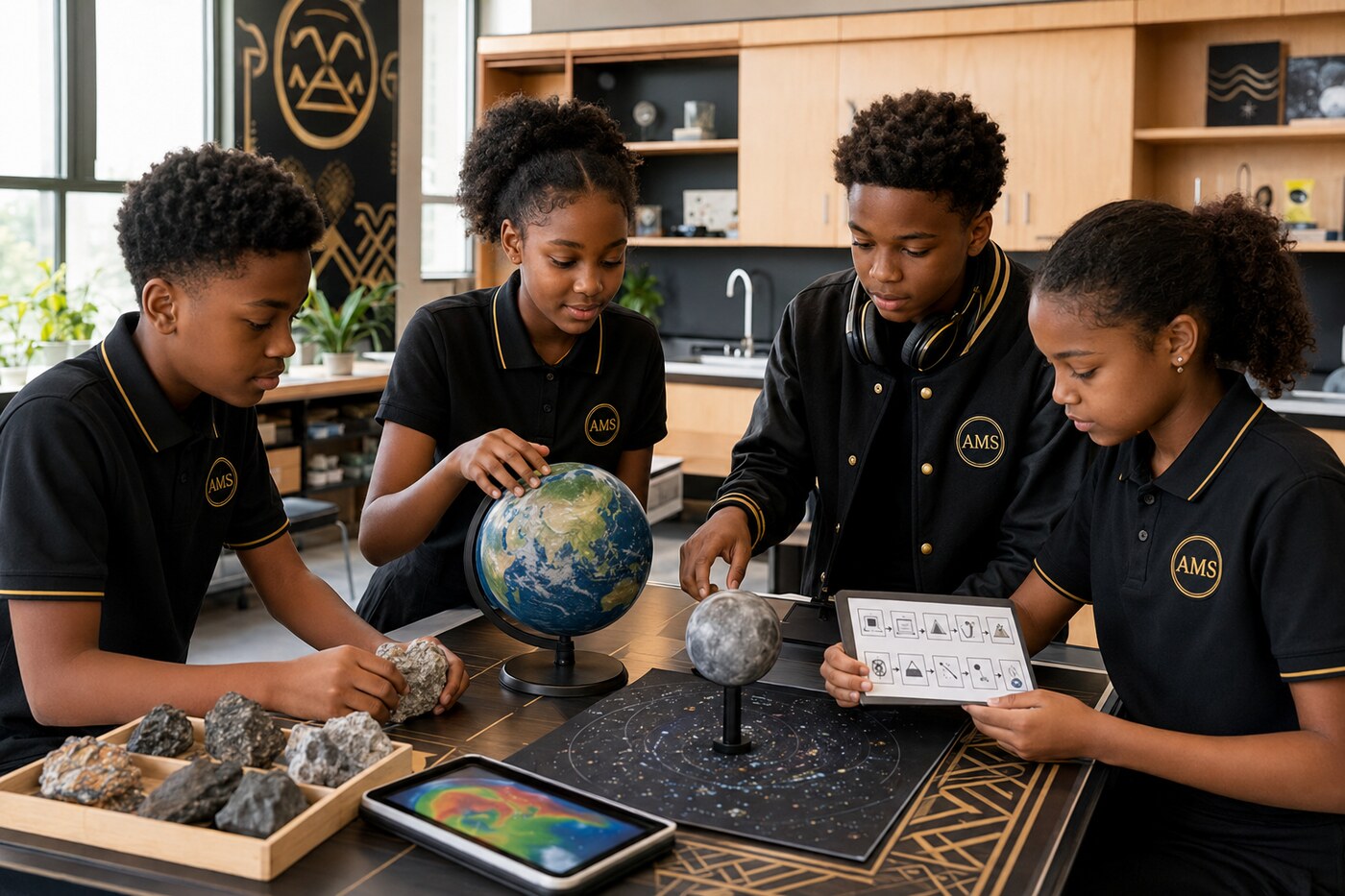
Students learn Earth science through observation, modeling, local data, and the environmental realities of New Orleans and the Gulf Coast. The curriculum connects geology, weather, water, climate, and human decisions.
Learning values community, memory, responsibility, wisdom, creativity, and relationships across generations.
Students receive explicit teaching, accessible materials, purposeful repetition, multiple representations, and multiple ways to demonstrate learning.
Reflection, dialogue, repair, collaboration, and growth replace fear-based discipline and unnecessary high-stakes testing.
Explain interactions among Earth's major systems
Use maps, models, measurements, and datasets
Investigate weather, water, rocks, landforms, and natural hazards
Connect Gulf Coast conditions to global Earth processes
Evaluate environmental claims and evidence
Design practical responses to local resilience challenges
Essential question: What can rocks and fossils tell us about change?
Core learning: Minerals; rock cycle; fossils; relative time; Earth history
Essential question: Why is Earth's surface always changing?
Core learning: Earth layers; plate movement; earthquakes; volcanoes; erosion
Essential question: How does water shape land and life?
Core learning: Water cycle; watersheds; rivers; deltas; wetlands; groundwater
Essential question: How do we read the atmosphere and prepare for risk?
Core learning: Air masses; fronts; pressure; forecasting; hurricanes; preparedness
Essential question: How does energy move through Earth and atmosphere?
Core learning: Radiation; convection; conduction; ocean-atmosphere interactions
Essential question: How do scientists know climate changes?
Core learning: Climate vs. weather; proxy data; trends; carbon cycle; uncertainty
Essential question: Why are some communities more exposed to environmental change?
Core learning: Coastal processes; subsidence; sea level; wetlands; infrastructure; equity
Essential question: How can communities make responsible Earth-system decisions?
Core learning: Systems thinking; field observation; data; tradeoffs; public communication
Students plan, create, revise, explain, and share a product that demonstrates both content learning and communication.
Students plan, create, revise, explain, and share a product that demonstrates both content learning and communication.
Students plan, create, revise, explain, and share a product that demonstrates both content learning and communication.
Students plan, create, revise, explain, and share a product that demonstrates both content learning and communication.
Progress reports describe what a student understands, can do independently, can do with support, and should learn next. Grades never stand alone without feedback.
Students receive another pathway to learn and another reasonable opportunity to demonstrate growth after feedback and practice.
Hands-on models and labeled diagrams
Local photographs, maps, and weather data
Pre-taught scientific vocabulary
Structured observation and lab templates
Captioned demonstrations and repeated trials
Choice of model, poster, report, or recorded explanation
Individualization: Teachers follow each student's IEP and use present-level data, accommodations, assistive technology, and specially designed instruction. Supports provide access without lowering the intellectual dignity of the work.
Each semester includes at least one opportunity for students to connect learning to family knowledge, New Orleans, Akan or African diasporic culture, a community concern, or a public audience. Participation options protect privacy and respect different family circumstances.
← Return to the complete curriculum