Akan-rooted
Learning values community, memory, responsibility, wisdom, creativity, and relationships across generations.
Academic Track · Grades 7–8
Reasoning, representation, repetition, and real-world problem solving
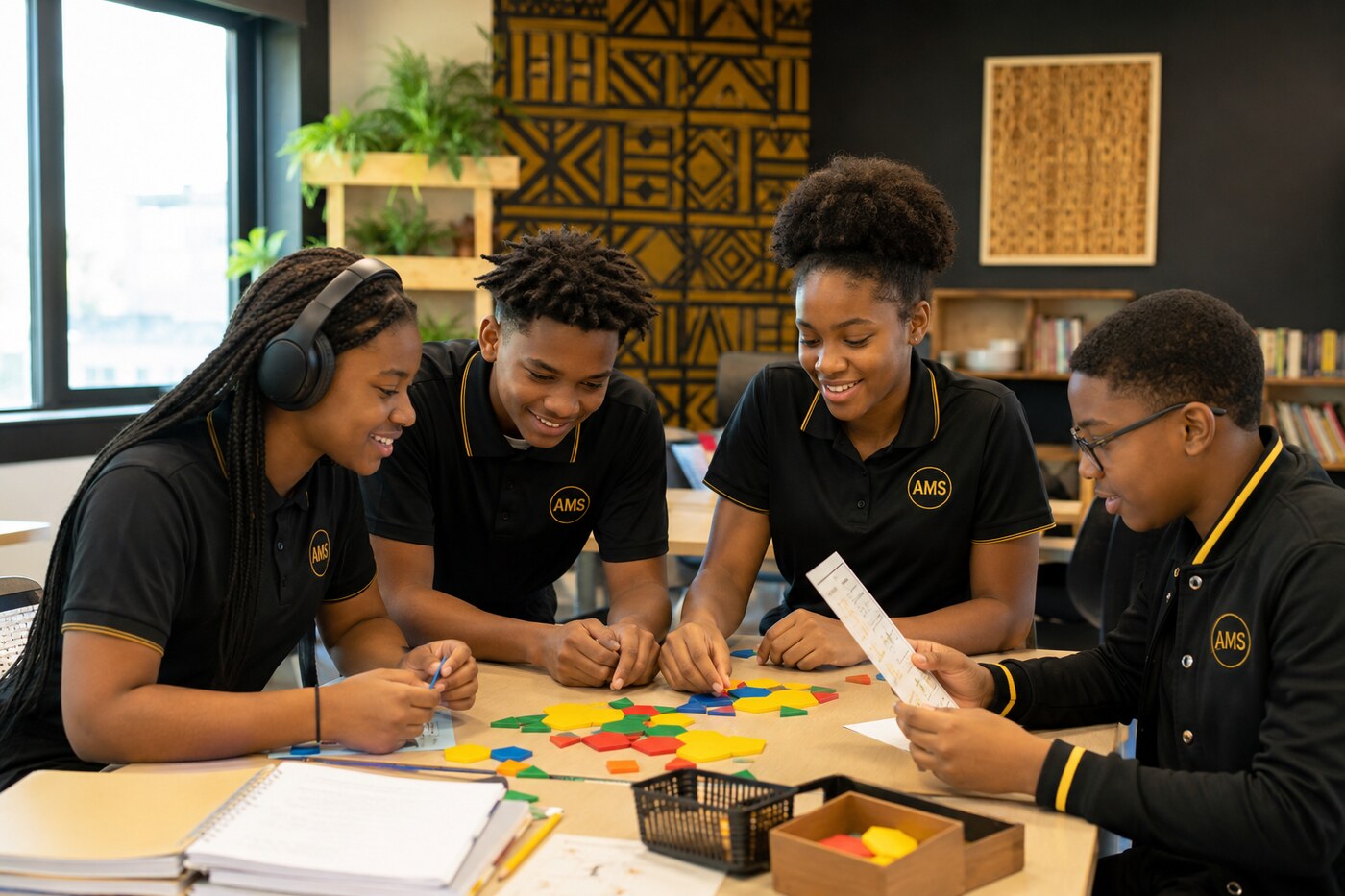
Students develop durable mathematical understanding through concrete models, visuals, discussion, music-supported repetition, and meaningful applications. Accuracy matters, but explaining thinking and selecting useful strategies matter too.
Learning values community, memory, responsibility, wisdom, creativity, and relationships across generations.
Students receive explicit teaching, accessible materials, purposeful repetition, multiple representations, and multiple ways to demonstrate learning.
Reflection, dialogue, repair, collaboration, and growth replace fear-based discipline and unnecessary high-stakes testing.
Build fluency without sacrificing conceptual understanding
Represent relationships with objects, drawings, tables, graphs, words, and symbols
Solve multi-step problems connected to daily life and community
Explain, compare, and revise mathematical reasoning
Use calculators and digital tools strategically
Recognize patterns and apply mathematics across subjects
Essential question: How can different representations make numbers easier to understand?
Core learning: Integers; fractions; decimals; percent; estimation; order of operations
Essential question: How do rates help us compare situations fairly?
Core learning: Ratios; unit rates; proportions; scale; percent change
Essential question: How can symbols describe a pattern or unknown?
Core learning: Variables; equivalent expressions; one- and two-step equations; inequalities
Essential question: How can measurement and data support decisions?
Core learning: Area; circumference; volume; sampling; graphs; probability
Essential question: How can change be represented and predicted?
Core learning: Slope; rate of change; tables; graphs; equations; systems concepts
Essential question: What makes a relationship a function?
Core learning: Functions; input/output; exponent rules; scientific notation; equations
Essential question: How can we reason about distance, shape, and movement?
Core learning: Transformations; congruence; similarity; angles; Pythagorean theorem
Essential question: How can data reveal a relationship without telling the whole story?
Core learning: Scatter plots; association; trend lines; data critique; cumulative review
Students plan, create, revise, explain, and share a product that demonstrates both content learning and communication.
Students plan, create, revise, explain, and share a product that demonstrates both content learning and communication.
Students plan, create, revise, explain, and share a product that demonstrates both content learning and communication.
Students plan, create, revise, explain, and share a product that demonstrates both content learning and communication.
Progress reports describe what a student understands, can do independently, can do with support, and should learn next. Grades never stand alone without feedback.
Students receive another pathway to learn and another reasonable opportunity to demonstrate growth after feedback and practice.
Concrete–representational–abstract instruction
Worked examples and color-coded steps
Abrafi Mathematics songs for retrieval practice
Reference charts and calculator access
Reduced problem sets with purposeful repetition
Multiple ways to show reasoning
Individualization: Teachers follow each student's IEP and use present-level data, accommodations, assistive technology, and specially designed instruction. Supports provide access without lowering the intellectual dignity of the work.
Each semester includes at least one opportunity for students to connect learning to family knowledge, New Orleans, Akan or African diasporic culture, a community concern, or a public audience. Participation options protect privacy and respect different family circumstances.
← Return to the complete curriculum