8:30 a.m.–3:30 p.m.
Proposed student day, Monday through Friday. Arrival, lunch, transitions and breaks are explicitly separated from instruction.
Rooted in Wisdom. Rising in Purpose.
Opening-Year Framework
A seventh-grade launch built around small instructional groups, continuity of support, and accountable special-education leadership.
Grades 7–8 · Development-stage planning
A predictable school day that protects literacy and mathematics while keeping science, history, culture, practical learning, and Capoeira Angola present.
Proposed, not adopted: These mock schedules are planning examples, not an enrollment promise, operating calendar, staffing assignment, or finding of legal compliance. Year One remains seventh-grade entry only. The eighth-grade example is for the advancing cohort in Year Two; there is no direct eighth-grade entry.
Proposed student day, Monday through Friday. Arrival, lunch, transitions and breaks are explicitly separated from instruction.
5 hours 45 minutes of instruction per day, plus 75 minutes of arrival, lunch, transitions and breaks.
120 minutes of reading / language arts and 90 minutes of mathematics: 50% of the full 420-minute day and approximately 60.87% of instructional time.
Use two shorter teaching sessions for each major skill subject instead of a single uninterrupted 90-minute lesson. Each 45-minute session includes explicit modeling, supported practice, checks for understanding, and independent or assisted demonstration.
| Time | Minutes | Activity / class | Instructional category |
|---|---|---|---|
| 8:30–8:40 | 10 | Arrival, breakfast / check-in | Not counted |
| 8:40–9:25 | 45 | English Language Arts · Session 1 | ELA |
| 9:25–9:30 | 5 | Transition / personal care | Not counted |
| 9:30–10:15 | 45 | Mathematics · Session 1 | Math |
| 10:15–10:25 | 10 | Sensory / movement break | Not counted |
| 10:25–11:10 | 45 | English Language Arts · Session 2 | ELA |
| 11:10–11:15 | 5 | Transition / personal care | Not counted |
| 11:15–12:00 | 45 | Mathematics · Session 2 | Math |
| 12:00–12:30 | 30 | Lunch and unstructured break | Not counted |
| 12:30–1:00 | 30 | Reading & Writing Lab | Literacy |
| 1:00–1:35 | 35 | Science 7 | Science |
| 1:35–1:40 | 5 | Transition | Not counted |
| 1:40–2:15 | 35 | History & Social Studies 7 | Social studies |
| 2:15–2:20 | 5 | Transition | Not counted |
| 2:20–2:50 | 30 | Capoeira Angola / Health & PE | Health / PE |
| 2:50–2:55 | 5 | Transition | Not counted |
| 2:55–3:30 | 35 | Cultural & Life Skills Studio 7 | Rotating studio |
The morning routine remains predictable as content develops. Afternoon subjects are staggered from grade 7 to illustrate shared-space planning; a final timetable must resolve every instructional group and specialist assignment.
| Time | Minutes | Activity / class | Instructional category |
|---|---|---|---|
| 8:30–8:40 | 10 | Arrival, breakfast / check-in | Not counted |
| 8:40–9:25 | 45 | English Language Arts · Session 1 | ELA |
| 9:25–9:30 | 5 | Transition / personal care | Not counted |
| 9:30–10:15 | 45 | Mathematics · Session 1 | Math |
| 10:15–10:25 | 10 | Sensory / movement break | Not counted |
| 10:25–11:10 | 45 | English Language Arts · Session 2 | ELA |
| 11:10–11:15 | 5 | Transition / personal care | Not counted |
| 11:15–12:00 | 45 | Mathematics · Session 2 | Math |
| 12:00–12:30 | 30 | Lunch and unstructured break | Not counted |
| 12:30–1:00 | 30 | Reading & Writing Lab | Literacy |
| 1:00–1:35 | 35 | History & Social Studies 8 | Social studies |
| 1:35–1:40 | 5 | Transition | Not counted |
| 1:40–2:15 | 35 | Science 8 | Science |
| 2:15–2:20 | 5 | Transition | Not counted |
| 2:20–2:55 | 35 | Cultural & Life Skills Studio 8 | Rotating studio |
| 2:55–3:00 | 5 | Transition | Not counted |
| 3:00–3:30 | 30 | Capoeira Angola / Health & PE | Health / PE |
| Area | Grade 7 emphasis | Grade 8 emphasis |
|---|---|---|
| ELA & literacy | Explicit reading, comprehension, paragraphs and evidence; targeted decoding as needed | Longer texts, argument, source comparison and revision; continued explicit reading support |
| Mathematics | Rational numbers, ratios, proportional reasoning, percentages, expressions and equations | Linear relationships, slope, equations / systems, geometry and data; foundation skills retaught as needed |
| Science | Evidence, investigations and grade-level life, physical, Earth and space science | Models, investigations and grade-level life, physical, Earth and space science; deeper analysis |
| History & Social Studies | Grade-level historical inquiry and U.S. history with African-diaspora connections | Grade-level Louisiana history, civics and source work with New Orleans connections |
| Capoeira / Health & PE | Safe routines, ginga, balance, listening, rhythm and health vocabulary | Controlled sequences, partner awareness, musical roles, reflection and health decisions |
Grade-level standards remain the planning reference. The named geoscience and interstellar-science units provide contexts within a complete science program; they must not leave life or physical science untaught. Storytelling is woven into daily literacy. Personal Finance Studio supplements mathematics rather than replacing the mathematics course.
Two different weights are shown below: instructional time and an optional school-designed overall summary. These are planning choices, not Louisiana-prescribed percentages.
| Class | Minutes / day | Minutes / 5-day week | Share of instruction | Proposed overall summary weight |
|---|---|---|---|---|
| English Language Arts + literacy lab | 120 | 600 | 34.78% | 25% |
| Mathematics | 90 | 450 | 26.09% | 25% |
| Science | 35 | 175 | 10.14% | 15% |
| History & Social Studies | 35 | 175 | 10.14% | 15% |
| Capoeira Angola / Health & PE | 30 | 150 | 8.70% | 10% |
| Cultural & Life Skills Studio | 35 | 175 | 10.14% | 10% |
| Total | 345 | 1,725 | 100%* | 100% |
*Individual instructional percentages are rounded and total 99.99% before rounding the total. Each minute is counted once.
Report individual course grades first. If the school adopts an overall progress average, calculate it as ELA × .25 + Math × .25 + Science × .15 + Social Studies × .15 + Health/PE × .10 + Studio × .10. For example, course scores of 80, 90, 85, 80, 95 and 90 produce 85.75. Do not use that combined number as the sole promotion decision or to conceal a student’s reading or mathematics needs.
Course level: All courses in this mock plan are regular, unweighted middle-school courses, with no honors bonus. These schedules do not award high-school Carnegie units or establish a high-school graduation pathway. Any future Algebra I credit offering needs a separately verified course and credit plan.
Both grades receive a 35-minute studio each day. Over a normal five-day week that is 175 minutes total, not 175 minutes for every elective. Each strand receives 35 scheduled minutes per week. Longer cooking or art projects can use a documented rotation with equivalent time across the cycle.
| Day | Studio strand | Grade 7 example | Grade 8 example |
|---|---|---|---|
| Monday | Akan Language | Greetings, listening, everyday vocabulary; visuals and AAC | Short dialogues, reading, cultural research and presentation |
| Tuesday | Afro-manga Art | Character, line, sequence and visual communication | Panel composition, revision and an original short comic |
| Wednesday | Cooking & Hygiene | Food safety, measurement, preparation and self-care | Meal planning, ingredient comparisons and growing independence |
| Thursday | Technology & Mobility | Assistive technology, digital safety, maps and help-seeking | Source evaluation, travel planning and digital production |
| Friday | Personal Finance | Money, prices, needs / wants and a simple budget | Comparing costs, saving, banking and consumer decisions |
Akan language can also appear in brief greetings and cultural connections throughout the day. Those integrated moments do not create extra instructional minutes. Dedicated studio lessons retain their own learning targets and evidence.
This draft uses several ways to show knowledge. An accommodation changes access without automatically changing the learning target. If a target is modified, record that clearly.
| Evidence category | Proposed weight | Examples |
|---|---|---|
| Demonstrated learning | 40% | Short skill checks, explanations, oral / AAC responses, models or an accessible assessment |
| Guided practice and application | 30% | Supported classwork scored for the target skill, with prompts and supports documented |
| Projects and portfolio | 30% | Writing samples, investigations, practical demonstrations, art, conferences and revised work |
Four quarters would contribute 25% each to the annual course grade. A draft ten-point reporting scale is A 90–100, B 80–89, C 70–79, D 60–69 and F below 60. These are proposed school policies, not a claim that every middle-school private course must use this scale. Studio reports should identify each strand so a combined mark does not hide different strengths.
Keep growth and access visible. Report individualized goal progress separately from course mastery; an IEP goal is not an extra graded subject. Attendance, compliance, eye contact, speech ability, speed, disability-related needs, and family help with homework should not substitute for evidence of learning. Provide accessible reassessment after reteaching.
Capoeira / Health & PE: use adapted skill demonstrations, music and cultural understanding, health knowledge, and reflection. Assess each learner’s documented targets and safe choices, not athletic talent, contact, inversions, or ability to perform the same movement as another student. Seated and non-movement roles remain meaningful options.
External assessment: this concept assigns LEAP or another annual external assessment 0% of routine course grades. That is a proposed local choice, subject to any applicable program or course rules; it does not excuse a required assessment.
Keep the planned group size of up to seven students with an educator and paraprofessional. Use visual schedules, first / then supports, AAC, assistive technology, chunked tasks, and individualized breaks. The 30-minute literacy lab is targeted instruction in reading or writing, not an unstructured study hall. Broader services and goal work must be scheduled from the actual student plan.
Academic and life-skills emphases may use the same timetable with different tasks and documented supports. A disability label does not automatically replace core subjects, change assessment eligibility, or make a student eligible for an alternate assessment. Additional service time must be placed deliberately, with missed instruction addressed.
Arrival, transitions, lunch, and the scheduled sensory break contribute zero instructional minutes in this model. Unplanned interruptions and additional breaks must be recorded accurately and addressed in the final calendar. Do not count the same period twice or assume that an activity becomes instructional merely by renaming it.
A planning year of 180 full instructional days at 345 instructional minutes gives 62,100 scheduled instructional minutes. An actual calendar must deduct holidays, closures, shortened days, and other lost instruction. Staff-only workdays are separate.
Bulletin 741 Nonpublic §117 sets an annual instructional-time requirement of 57,750 minutes and excludes lunch, recess and class changes. Section 2103 requires approved nonpublic grades 1–8 to devote at least half the school day to reading, language arts and mathematics. This concept reserves 210 of 420 minutes for those subjects. Source: BESE Bulletin 741 Nonpublic, §§117 and 2103 (reviewed November 13, 2026).
The difference between 62,100 and 57,750 is 4,350 minutes; this is a planning margin, not permission to cancel instruction or a determination that all attendance and calendar rules are satisfied.
These are student templates, not a completed staffing master schedule. Four groups of seven would require 120 group-minutes of Capoeira instruction per day if taught separately. Ten groups would require 300; twenty groups across both grades would require 600. One specialist cannot deliver 600 minutes within this student day. The opening plan must fund adequate qualified instructors, planning time, support, safe spaces and staggered sessions; it must not quietly combine groups beyond the seven-student commitment.
Not automatically just because the school is in Louisiana. The applicable requirement depends on the school’s actual category, the student’s funding / placement arrangement, and current program rules. No school category or testing program is adopted by this concept page.
| School / student situation | Assessment position | What Aberewa must resolve |
|---|---|---|
| Private school not seeking state approval | LDOE states that state testing is not required for students in this category. It describes optional grade 4 and 8 LEAP access through the local school system. | This category has distinct approval, records and transfer implications; it is not a testing exemption for every private school. |
| BESE-approved private school, ordinary private enrollment | Do not infer a universal LEAP mandate from approval alone. Confirm the actual school category, testing arrangements, accreditation conditions and any funding agreements. | Choose an assessment plan and confirm applicable duties with LDOE before enrollment. |
| LA GATOR participating students | Annual ELA and mathematics assessment is required under the program. Current law and LDOE policy allow state assessments or BESE-approved nationally norm-referenced alternatives; other aligned assessments require BESE approval. | Document the approved test, grade levels, accommodations, testing window, costs and reporting. LEAP is not the sole permitted option. |
| Other scholarship, placement or funding arrangement | Apply the current requirements of that specific arrangement; they may differ from LA GATOR. | Do not reuse old scholarship testing guidance without verifying the current program and school year. |
Disability and testing: follow the selected assessment’s accommodation rules and the student’s applicable documentation. LA GATOR law preserves exemptions that would apply to the student in public school. Autism, SLD, an IEP, or placement in a life-skills group does not by itself establish an exemption or alternate-assessment eligibility.
Proposed planning sequence: confirm the approval and funding model; identify covered students; choose the permitted assessment; budget administration and staff training; verify accommodations and test security; publish a family testing calendar; report results through the required process. Use classroom evidence and growth information alongside the external results.
Sources checked November 13, 2026: LDOE: nonpublic schools not seeking state approval; R.S. 17:4037.10; LDOE LA GATOR policy, Assessments; LDOE July 2026 nonpublic webinar. Confirm the operative requirements for the actual opening year before adoption.
The daily Health & PE block combines progressive movement, safe practice, music and health instruction; it is not thirty minutes of continuous exertion. Cultural connections also appear in reading, history, patterns, rhythm and art. Capoeira remains the only planned school sport, inspired by Mestre Curtis Pierre’s published approach. Every depicted participant wears the same Aberewa emblem uniform and athletic shoes. Free adult classes and guest visits are separate from student instructional minutes.
Explore the Capoeira Angola program · Review the opening-year model · Ask a scheduling or testing question
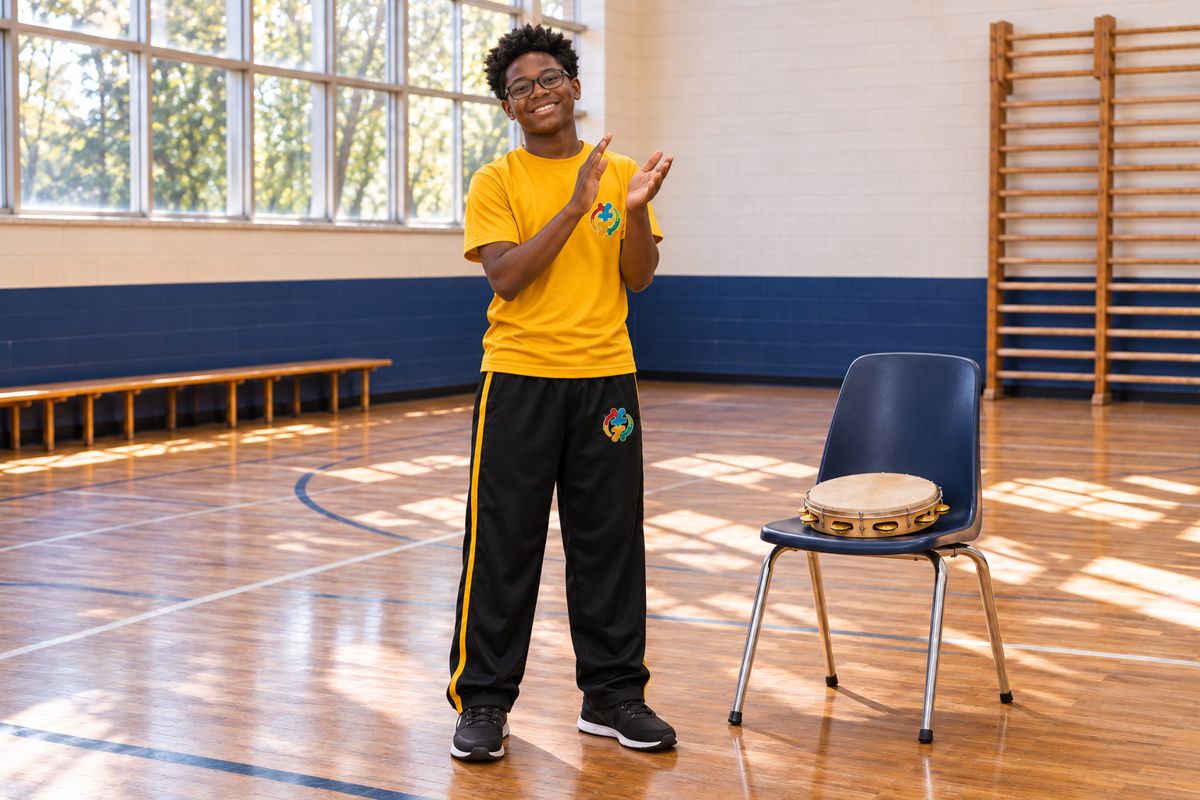
Movement · Music · Community
Build qualified instruction, accessible space, instruments, supervision, and training clothing into opening plans. Capoeira Angola is the only planned school sport; implementation depends on staffing, facilities, and readiness.
Our schoolwide approach is inspired by Mestre Curtis Pierre’s work in New Orleans, with attention to fluid movement, balance, flexibility, music, and cultural history.